
You Want to Save a Child? Learn Not to Rush the Brisket

Updated: Jul 22
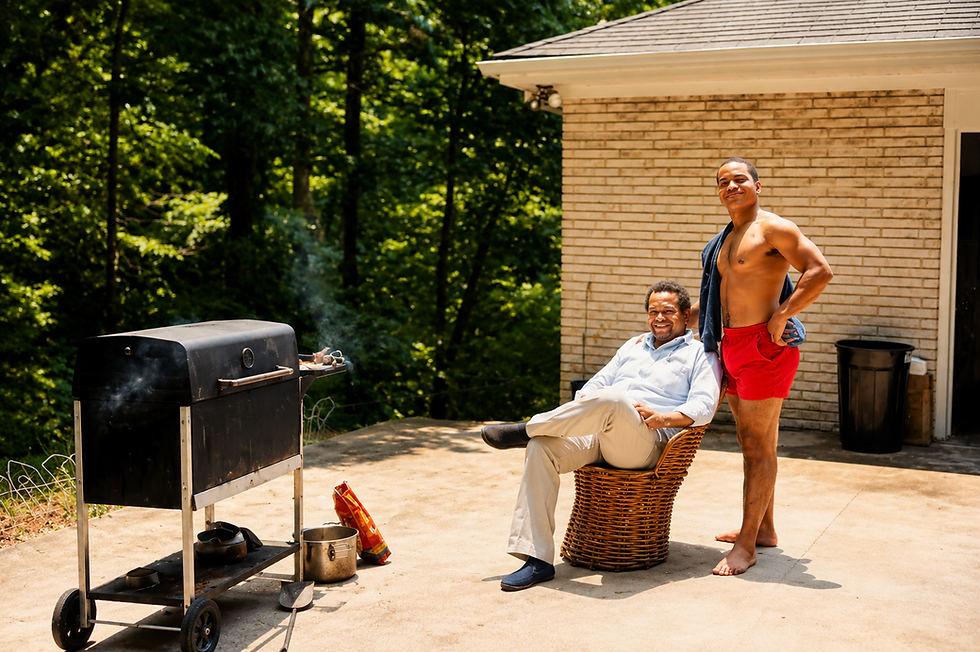
It was a Saturday morning during the summer while I was home from Morehouse College.
During the week, I worked the early shift on the tarmac at Hartsfield-Jackson International Airport, loading and unloading airplanes. Saturdays were sacred. They were my chance to sleep in, and that morning I had taken full advantage of it.
When I finally woke up, I noticed the garage door was open.
I knew exactly where Pop would be.
I walked through the garage wearing nothing but a pair of shorts.
No shoes. No socks. No shirt.
I had only stepped outside to say hello before going back into the house, and back to sleep.
Instead, I ended up receiving one of the greatest lessons of my life.
Pop was sitting beside his old barrel grill in one of the wicker chairs that had traveled with our family from Liberia, to South San Francisco, and finally to East Point. The charcoal had been burning for hours, and thin ribbons of smoke drifted into the sky. He looked perfectly content, as if there were nowhere else on earth he would rather have been.
There was nothing my father enjoyed more than simply being with family.
If two or three of us happened to be talking when he walked into the room, he'd stop, put his hands on his hips, look around suspiciously, and say, "Hold on a minute now... are y'all having a family reunion behind my back?"
Then he'd laugh before anybody could answer, pull up a chair, and make himself part of the conversation.
He genuinely enjoyed being together with all of us.
Looking back now, I realize those moments weren't accidental, as Pop seemed to understand that ordinary conversations often become the memories that outlive us.
When he looked up and saw me standing there, he grinned.
"Well, look at you, Mr. Hilliard."
He slowly looked me up and down.
"You've got sleep in your eyes...and you don't have on any clothes."
"I have on shorts, Pop, and I just woke up."
"Oh," he said with exaggerated seriousness, "excuse me, Mr. Hilliard. You have on shorts."
We both laughed.
I walked over and stood beside him while he remained in the wicker chair. I never sat down because I wasn't planning to stay.
But Pop had other plans.
He wanted to catch up with what was going on in my life.
Then, just as naturally as breathing, the conversation changed. It always did. Somewhere in the middle talking, Pop would quietly begin teaching, and if you weren't paying attention, you'd miss the moment it happened.
He lifted the lid of the barrel grill.
"Come here, into my office, Mr. Hilliard," he said.
I leaned over.
"You see where I put the coals?"
"Yes, sir, I said."
"Where are they?"
"On one side of the grill."
He smiled as he began with what I knew would be a lesson.
"EXACTLY. You don't put the coals underneath the meat. Folks get impatient. They want barbecue in a hurry, so they burn everything trying to cook it too fast."
He shook his head as he explained.
"You can't rush good barbecue, Mr. Hilliard. No sir!"
Smoke rolled out of the grill as he pointed inside.
"Now pay attention."
I'd heard this lesson before.
Actually, I'd heard it almost every time Pop cooked.
But it didn't matter to him.
He taught it the same way every single time.
He pointed toward the bottom of the grill.
"First, the Cornish hens, Mr. Hilliard."
"Why?"
He looked over at me with that grin I knew so well.
"Mr. Hilliard... you don't know?"
"No, sir."
"You have to pay attention, Mr. Hilliard."
Then he laughed.
And in his best British accent, he said "[t]he Cornish hens take the smoke beautifully, and they don't burn as quickly as everything else. They protect the meat above them."
He pointed a little higher.
"Then the ribs."
His finger moved again.
"Then the brisket."
"Why the brisket?"
"Because that's the meat that has to cook the slowest. Oh, Mr. Hilliard, lest we forget!"
He smiled and gently tapped the lid of the grill.
"We ain't in a hurry with the brisket, Mr. Hilliard."
Then he chuckled.
"The brisket needs time."
"You don't rush the brisket."
Finally, he pointed to the top.
"Sausage goes up here."
He closed the lid.
"Now tell me the order, sir," he instructed
"Cornish hens."
He nodded.
"Ribs."
Another nod.
"Brisket."
"Good."
"Sausage."
He smiled.
"Mr. Hilliard might actually be learning something, and you may soon be eligible for a P.H.D. in barbeque!"
I laughed.
"Pop, you tell me this every time."
He looked back toward the smoke.
"That doesn't mean you know it."
Then he turned toward me.
"Hearing something and knowing something are two different things."
He let that sit there for a moment before continuing.
"I don't want to leave this world and have you standing around trying to figure out how I made my barbecue."
"I'll figure it out."
He immediately pointed at me.
"No, you won't.
I laughed.
"You think you'll figure it out because you've eaten it."
He shook his head.
"EATING barbecue and knowing how to MAKE barbecue are two different things."
Then he leaned back into the wicker chair and looked toward the smoke.
"One day you're going to miss this barbecue."
His voice became softer.
"You may even miss me."
I smiled.
"I probably will."
He smiled back.
"Then you'd better pay attention.
For a few moments, neither of us said anything. We simply watched the smoke rise into the sky.
Then Pop looked at me and said something that completely changed the direction of the conversation.
"You know, Hawk..."
"Educating children works exactly the same way."
I looked at him.
"What do you mean?"
He rested his hand on the lid of the grill for a moment before answering.
"Hawk, if this brisket doesn't come out right today, whose fault is it?"
"I don't know."
He smiled.
"That's because you haven't been paying attention."
I laughed.
"No, really. Tell me."
He pointed toward the grill.
"If I take that brisket off too early because I get impatient, whose fault is it?"
"Yours."
"If I let the fire get too hot and burn it, whose fault is it?"
"Yours."
"If I put it in the wrong place on the grill, whose fault is it?"
"Yours."
He nodded.
"Exactly."
"The brisket didn't fail."
"I failed the brisket."
He let that settle between us before he continued.
"So why is it that when children struggle, we immediately decide something is wrong with the child?"
I didn't answer.
I had never thought about it that way.
He looked back at the smoke rising from the grill.
"We don't study the teacher."
"We don't study the classroom."
"We don't study the method.
"We study the child."
"And after we've studied the child long enough, we convince ourselves the child is the problem."
He slowly shook his head.
"I've never believed that."
He picked up the barbecue fork and gently moved one of the pieces of meat.
"Good teachers aren't magicians, Hawk. They don't have gifts that other people don't have."
"So what do they have?" I asked.
"They pay attention."
He smiled
"They watch teachers whose children are learning."
"They ask questions."
"They borrow what works."
"They practice it until it becomes their own."
"They don't let pride keep them from learning."
Then he laughed.
"You know what gets grown folks in trouble?"
"What?"
"They'd rather invent a brand-new method than admit somebody else already figured one out."
I laughed.
"So you're saying teachers copy each other?"
"I'm saying successful people study success."
He looked at me.
"That's true whether you're talking about teaching, practicing law, cooking barbecue, or raising children."
He closed the lid of the grill again.
"Good barbecue and good teaching have something in common."
"They both require patience."
"And they both require a method."
I asked him, "So where did your method come from?"
He smiled.
"I'll tell you."
"When I was in graduate school, your mother and I already had three children. I had a scholarship and a small stipend. I couldn't afford to make bad grades, or I'd lose my scholarship. So I had to figure out how to learn."
He looked at me as though he were back in graduate school all over again.
"I started going to every class."
"I took detailed notes."
"When I got home that afternoon, I rewrote every one of them in my own words."
"The next day I did the same thing."
"Then every night, before I went to bed, I started with the very first day of class and reviewed everything I'd learned all the way to that day."
I interrupted him.
"Every night?"
He smiled.
"Every night."
"I didn't just review that day's lesson."
"I reviewed all of them."
"By the time the exam came around, I wasn't trying to learn the material."
"I already knew it."
Then he laughed.
"And after I started doing that..."
"I never made less than an 'A' again."
I just stood there looking at him.
Years later people would ask me, "What was Dr. Hilliard's method?"
They expected something mysterious.
Something complicated.
It wasn't.
It was discipline.
It was consistency.
It was believing that understanding is built one faithful day at a time.
In our family it simply became known as The Method.
Go to class.
Take careful notes.
Rewrite them in your own words.
Review everything from the beginning every single night.
Repeat until the knowledge belongs to you.
Ace learned the The Method. Robi and Trish learned it too.
I learned The Method too.
It carried me through Morehouse.
It carried me through law school.
Even today, when I have something difficult to master, I find myself going back to pieces of it.
That Saturday morning beside the grill wasn't unusual.
It was who Pop was.
Whether he was speaking before educators, teaching graduate students, sitting at our dinner table, or talking to his youngest son beside a barrel grill, he was doing the same thing.
He was teaching.
Only the classroom changed.
His life's work became proving that children, especially Black children who had been underestimated, mislabeled, and written off, possessed extraordinary intellectual capacity when adults were willing to improve their methods instead of lowering their expectations.
He challenged teachers.
He challenged researchers.
He challenged universities.
But most of all, he challenged all of us to stop asking, "What's wrong with this child?"
before first asking, "What haven't I learned about teaching this child?"
Standing there beside that grill, I honestly believed Pop was making sure that after he was gone I'd know how to cook his barbecue.
It never crossed my mind that he wasn't teaching me how to smoke brisket.
He was teaching me how to think.
Every now and then, when I smell charcoal beginning to burn or hear the hiss of smoke rolling out from under the lid of a grill, I find myself right back in that backyard.
I can still hear him laughing.
"Mr. Hilliard... you don't know."
"You have to pay attention, Mr. Hilliard."
He was right.
I was paying attention.
It just took me a few years to understand what he was really teaching.
Before my father ever blamed the brisket, he examined the fire, the placement, the temperature, and The Method. He believed children deserved the same grace.
Before we decide a child cannot learn, we should first have the humility to ask whether we have learned how to teach.


Comments