
THE DAY “THE AFRICAN IN ME” STOOD TRIAL

Updated: Aug 10
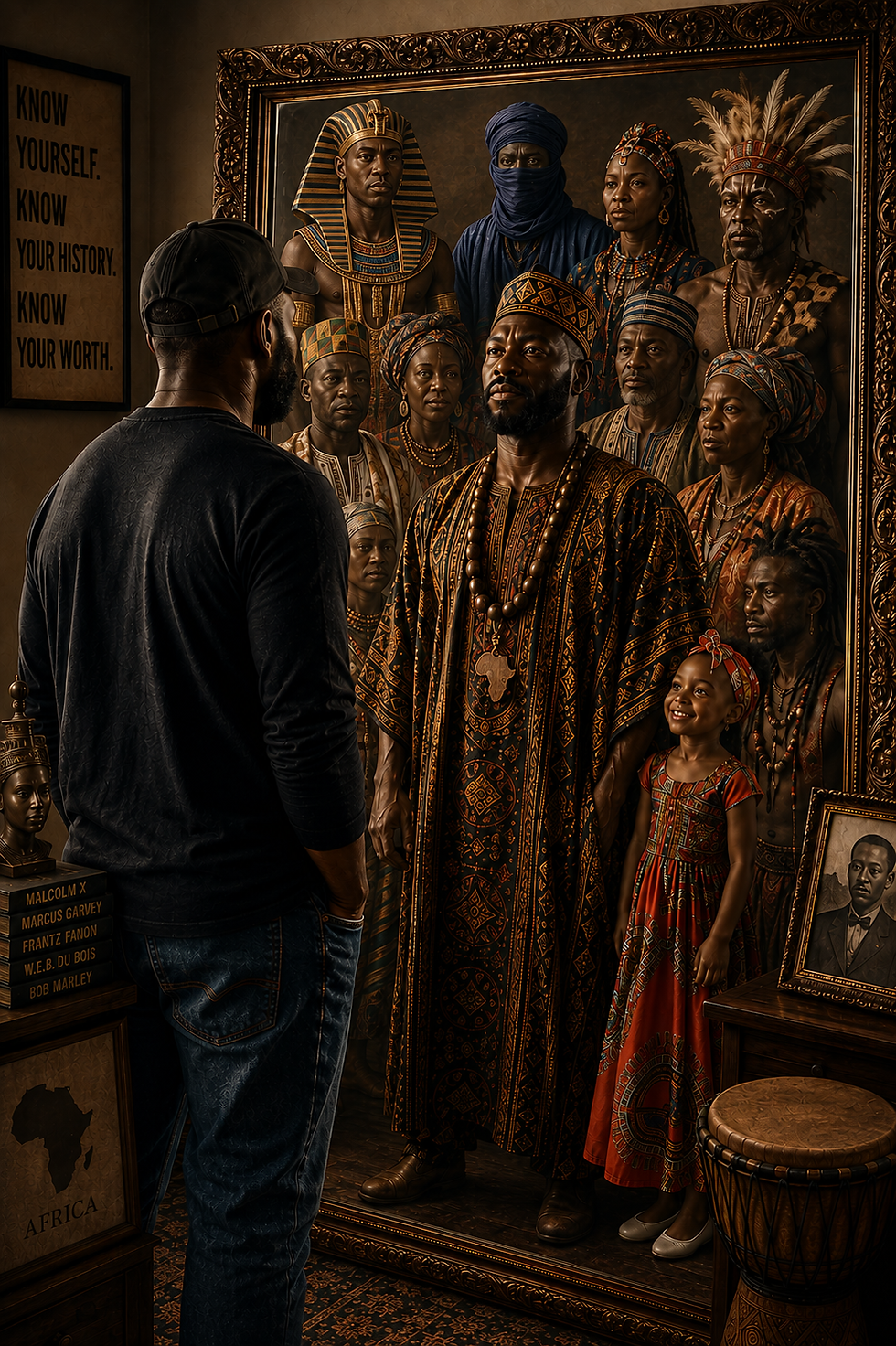
“Man, you keep talking about Africa.
I ain’t never been to Africa.
I ain’t going to Africa.
Don’t know no village, don’t speak no African language, and don’t particularly want to.
I’m BLACK.
I’m from here.
Africa ain’t got nothing to do with me.”
And there it was, the oldest wound wearing the clothes of certainty, a son asking his mother to prove the birth because somebody stole the family Bible.
So the African in me stood trial. The prosecution brought the ocean, the missing names, the broken languages and family trees disappearing at auction blocks, then pointed toward Georgia, Mississippi, Alabama, Chicago and Detroit and declared, “This is where your story begins.” For a moment, the room almost believed them. Then an old woman whose name did not survive the crossing rose without being called. She brought no papers, named no village, offered no pedigree. She simply lifted her face. And her face testified. “You don’t know your African name.” Of course I don’t. Somebody needed me not to. “You don’t speak the language.” Is there not a difference between having no language and having your language taken from you? “You don’t know the village.” Does the kidnapped child cease to have a home because he cannot find his way back? “You’ve never been to Africa.” True. But does never seeing your grandmother mean she isn’t your grandmother? Brother, be careful. Are you building your case with evidence from the crime? The missing name, the missing language, the missing village are not proof that there was nothing before America. The prosecution offered the very evidence supporting my innocence and called it proof of my guilt. I called them fingerprints. I do not blame the brother who hesitates at the word African. How could I, when so much was invested in teaching him to resist what he might find there? Who decided what beautiful looked like? Who called his hair bad before he was old enough to comb it, mocked his wide nose before he knew whose nose he carried, and called Africa primitive before he was ever taught what Africa had built? If Africa was handed to him first as insult instead of inheritance, should I condemn him for hesitating at the name, or should I ask who taught him to hesitate? And if the body was all they wanted, why work so hard on the mind? Why take the name after taking the labor? Why forbid the reading? Why break the language, separate the child from the people, then ridicule the Africa they worked so hard to make him forget? Maybe somebody understood that if you could make a people forget where they came from, one day their children might offer the forgetting as proof they never came from there. Brother, that is why I ask you to consider the evidence. Your family did not begin in Georgia, Mississippi, Alabama, Chicago or Detroit. America is part of your story. It is not the beginning of it. Your ancestors were not slaves who somehow became people. They were people somebody enslaved, with names before they were renamed, families before they were separated, histories before captivity entered their story. Enslavement is what they endured. It is not who they were.
Somewhere in my blood was some brother whose mother’s father’s brother’s cousin, sitting in the belly of a ship headed toward a place he never chose.
He never knew my name, never saw my face, but somewhere beyond his own tomorrow, that brother prayed me into existence.
Think about that, Brother.
You may be one of the children he prayed into existence.
How could his child become evidence that he never existed? Call yourself Black. I love Black.
I know race was constructed.
But what we made from Black is REAL.
Black and White were made into colors for people, lines drawn between us that were never there from the beginning.
But we took Black and made it a people, a culture and a home.
Still, the name we built after the rupture does not erase who we were before it. We took Black and filled it with beauty and brilliance, gospel and jazz, scholarship and swagger, resistance and a way of making enough when almost nothing was placed in our hands. But I will not make Black an orphan just to prove how much I love it. Black has a before. America has a before. You have a before. Brother, you don’t have to go to Africa for Africa to be part of you. These soup coolers, this wide nose, this kinky hair bunching at the back of my neck, the very things somebody once entered into evidence against me, are my calling card. I spent enough time hearing what somebody else thought they meant. Now I let them testify. My face is the star witness. It cannot tell me the village. It cannot speak every language or recover every stolen name. But it can remind me that America did not create me, captivity did not conceive me, and the plantation was never the womb of my people. So don’t ask me to prove Africa. Ask why history worked so hard to make me deny her. Perhaps this case was never really about whether you have been to Africa. Perhaps it is about whether Africa had to disappear from your memory before you could believe she disappeared from you. How free can I be if freedom reaches my body but never reaches my memory? Long before this courtroom, my ancestors understood that truth could be weighed, so I place my heart upon the ancient scales of Ma’at and stand by my testimony, my heart deemed lighter than the feather. Res judicata. The matter has been judged. This case will not be tried again. The verdict was waiting in the mirror. So Brother, the next time somebody asks if you are African, before you answer with everything you cannot remember, consider the evidence. Consider the names we cannot recover, the languages we cannot speak, the villages we cannot find and the ancestors who can no longer rise to introduce themselves. Do not mistake their silence for their absence. Somebody whose name you may never know survived long enough, prayed hard enough, lived long enough for the possibility of you. You are one of the children they prayed into existence. So before you answer, Brother, look again. Your memory may have lost the name. Your face never lost the truth.


Comments