
TELL THE TRUTH OR SAY NOTHING AT ALL

Updated: Aug 30
Khun-Anup, Ma’at, and an Inheritance of Justice

My father said it over and over again:
Don't let anybody tell you your story began with slavery.
You were enslaved.
There is a world of difference between those two sentences.
One describes something somebody did to you.
The other tries to make what they did who you are.
So pull the timeline backward until the chains fall off.
Go beyond America, beyond Europe, beyond Rome and Greece, and follow the Nile into ancient Africa, where Ta-Seti, Nubia, Kush and Kemet force us to confront something generations of Black children were never taught to expect:
African people are already there.
Building. Governing. Thinking. Writing. Worshipping. Raising families. And wrestling with one of the most difficult questions humanity has ever asked:
How do human beings live together without allowing power to become the only law?
In Kemet, that conversation had a name.
Ma’at.
Truth and justice, balance and right order, the proposition that the person with the biggest army, the fullest treasury or the highest seat in the room still does not get to decide for himself what is right.
And then they left us this image.
Look at it.
Don't let anybody explain it away before you have allowed your own eyes to see it.
There is a human heart.
There is a feather.
There is a scale.
There is judgment.
There is a record being kept.
There is a presiding authority.
There are assessors assembled above the proceeding.
And the questions being answered are not abstract.
Did you steal? Did you commit violence? Did you falsely accuse another? Did you take what belonged to somebody else? Did you close your ears when truth was speaking?
The deceased is not merely standing there waiting to be judged. He is giving an account of how he lived.
I have not stolen.
I have not committed robbery with violence.
I have not falsely accused anyone.
I have not closed my ears to truth.
And then look again at the scene: the heart on one side, the feather of Ma’at on the other, Anubis attending the balance, Jehuti keeping the record, Osiris presiding, the assessors above.
The question is not whether the person was important.
The question is whether the life they lived could stand against the standard.
Look at those fourteen figures and tell me the modern courtroom does not come rushing into your mind: twelve jurors and two alternates, a judge, a record, a person standing in judgment, and the scales of justice still hanging over the whole conversation.
The institutions are separated by thousands of years, but the question is unmistakable:
By what standard shall a human being be judged?
In that ancient African image, the heart is weighed against the feather of Ma’at.
Not against the heart of the richest man.
Not against the king.
Not against the person who happened to have the most power.
Against the standard.
And accompanying that ancient moral world were declarations about conduct:
I have not stolen.
I have not committed robbery with violence.
I have not falsely accused anyone.
I have not closed my ears to truth.
That last one ought to stop every lawyer reading this.
Because justice requires more than somebody brave enough to tell the truth.
It requires somebody powerful enough to hear it who is still honorable enough to listen.
And if you come from the Christian tradition, none of this should require you to leave God behind.
Christianity enters human history at a particular time.
God does not.
If God is eternal, God was present before anybody used the word Christian.
So finding African people contemplating God, righteousness, judgment, moral accountability, eternal existence and the weighing of human conduct thousands of years before Christianity should not make God smaller.
It should remind us that God was already there.
And then something happened that makes this ancient philosophy considerably more than beautiful words.
Somebody had to practice it.
His name was Khun-Anup.
He was a poor African trader traveling to market with donkeys carrying goods for his family when a man named Nemtynakht blocked his path, created the circumstances to trap him, beat him and took his goods.
Khun-Anup eventually carried his grievance before the powerful official Rensi, son of Meru. He did not petition once. He returned again and again, nine petitions in the surviving story, and his words became important enough to be written down for the king.
And history gave him a title:
THE ELOQUENT PEASANT
I have to smile at that.
Because Black people know something about being called eloquent.
Or articulate.
Sometimes it is a compliment.
And sometimes there is just enough surprise hiding inside the compliment that you can hear the sentence they had the good sense not to finish:
That Black man is so articulate.
Well, nearly four thousand years ago, somebody looked at this poor African peasant and apparently couldn't get over the power of his words either.
And Lord, could that African speak.
Nemtynakht could take his goods.
He could take his donkeys.
He could exploit his poverty.
He could beat the man.
But he made one enormous mistake:
he left Khun-Anup holding the truth.
And truth in the hands of somebody who knows how to use it can become dangerous to power.
Khun-Anup carried that truth before Rensi.
One man had governmental authority.
The other had a grievance.
One man occupied the high seat.
The other was the poor man asking to be heard.
And Khun-Anup did not merely ask for his property back.
He made justice explain itself.
And listen to the language this poor African man used when he spoke to power. Khun-Anup called Rensi the “RUDDER OF HEAVEN,” the “BEAM OF EARTH,” and the “PLUMB-LINE THAT CARRIES WEIGHT.”
Then he gave him a warning worthy of every judge who would ever sit above another human being: RUDDER DO NOT DEVIATE. BEAM DO NOT TILT. PLUMB LINE, DO NOT SWING.
Think about what Khun-Anup was saying nearly four thousand years ago: If you have been given the power to steer justice, then you have an obligation to steer it straight.
He spoke about the obligation of authority to protect the vulnerable. He invoked the orphan and the widow. He demanded that the person entrusted with justice actually do justice.
And suddenly this wasn't about some donkeys anymore.
Khun-Anup had taken that ancient scale down from the sacred wall and placed Rensi's heart on it.
Because that is the radical proposition hiding inside Ma’at:
the person holding the scale can be weighed too.
Khun-Anup's argument was devastating because he understood something every lawyer should understand: the greater your authority, the greater your obligation not to bend the line. A crooked man is dangerous, but a crooked judge can make crookedness look like law. Khun-Anup was demanding that the rudder of heaven steer straight.
The judge does not own justice.
The lawyer does not own truth.
The government does not own righteousness.
Power does not become right merely because it has enough power to punish the person who says it is wrong.
Everybody answers to the feather.
And now those ancient declarations come alive.
Nemtynakht takes another man's property:
I have not stolen.
Violence is used against the vulnerable:
I have not committed robbery with violence.
An accusation becomes the instrument of the taking:
I have not falsely accused anyone.
Khun-Anup stands before power demanding to be heard:
I have not closed my ears to truth.
Do you see what just happened?
Ma’at walked outside.
It left the sacred image, got dust on its feet, got robbed on an African road and walked into the presence of government demanding to know whether people who talked about justice were prepared to practice it.
That is jurisprudence.
And the poor man kept coming back.
NINE TIMES.
He spoke so powerfully that his words were preserved.
Think about that.
Nearly four thousand years ago, an African peasant's argument mattered enough for somebody to keep the record.
The donkeys are gone.
The merchandise is gone.
Nemtynakht is gone.
Rensi is gone.
The king is gone.
The dynasty is gone.
But somebody kept the record.
And that ought to bother every liar who has ever counted on time to bury the truth.
Sometimes somebody keeps the papyrus.
Sometimes somebody remembers the name of the poor man.
Sometimes the lie gets thousands of years to run,
and truth still catches it.
SO TELL THE TRUTH OR SAY NOHING AT ALL.
Tell the truth about Africa.
Do not open the history book at the slave ship and pretend you have reached the beginning.
Those Africans were enslaved after already belonging to history.
They were enslaved after African people had built civilizations,
contemplated God, created systems of government and learning, and wrestled with the meaning of justice.
They were enslaved after an African conception of judgment had placed the human heart against a feather.
They were enslaved after Africans had imagined a standard before which rich and poor, powerful and powerless, ultimately had to answer.
They were enslaved after a poor African man had stood before governmental power and argued that authority must answer to justice.
The chain came later.
Much later.
And I hope everybody hears this, whatever your race and wherever you live.
But I want the young Black man thinking about law school to hear me particularly clearly.
I want the young Black woman studying for the LSAT to hear me.
I want every attorney of African descent, wherever you are scattered throughout the diaspora, to hear me.
Because perhaps you have been taught that when you became a lawyer, you entered somebody else's ancient conversation about justice.
Perhaps somebody taught you the history of jurisprudence in a way that made your ancestors appear only after the architecture was already built.
Look again.
You are not merely descendants of people who eventually received permission to practice law.
You are descendants of people who were among those wrestling with the architecture of justice near the beginning of the surviving human record.
Your ancestors were asking what truth requires, what power owes the powerless, whether property may be wrongfully taken, whether accusation can become injustice, whether the person entrusted with judgment has an obligation to listen, and whether there must be a standard standing above human authority.
So you do not enter this conversation as a beggar.
You are not standing outside jurisprudence asking somebody to let you in.
Your intellectual ancestry reaches into the ancient human conversation about what justice means.
So walk into that law school differently.
Walk into that courtroom differently.
Study everybody they put in front of you.
Learn the common law. Learn the Constitution. Learn the cases. Learn Greece and Rome. Learn every damn thing you can learn.
But don't confuse what you are learning now with where the human conversation about justice began.
Walk in like an heir.
Walk in like somebody coming home to an inheritance that was hidden from you but never ceased belonging to history.
And when somebody talks to you as though civilization found your ancestors in chains, make sure they understand who they are talking to.
Because your story didn't begin when somebody captured you.
Your story didn't begin when somebody named you.
Your story didn't begin when somebody prohibited you from reading.
And it certainly did not begin when somebody finally allowed you to practice law.
You were there in the beginning.
And somewhere near the beginning of humanity's recorded struggle with justice stands a poor Black African man named Khun-Anup, stripped of almost everything except his voice, carrying truth into the presence of power.
They called him ELOQUENT.
Nearly four thousand years later, the record still remembers what he said.
And perhaps that is the final lesson every lawyer ought to carry:
Tell the truth when power would rather hear silence. Keep the record when somebody needs the truth forgotten. Hear truth even when it arrives dressed in poverty. And never confuse the person holding the scale with the justice the scale is supposed to serve.
Because power eventually dies.
Kings eventually die.
Lawyers eventually die.
Judges eventually die.
Even civilizations eventually fall.
But somebody kept Khun-Anup's words.
And nearly four thousand years later,
truth is still in his hands.
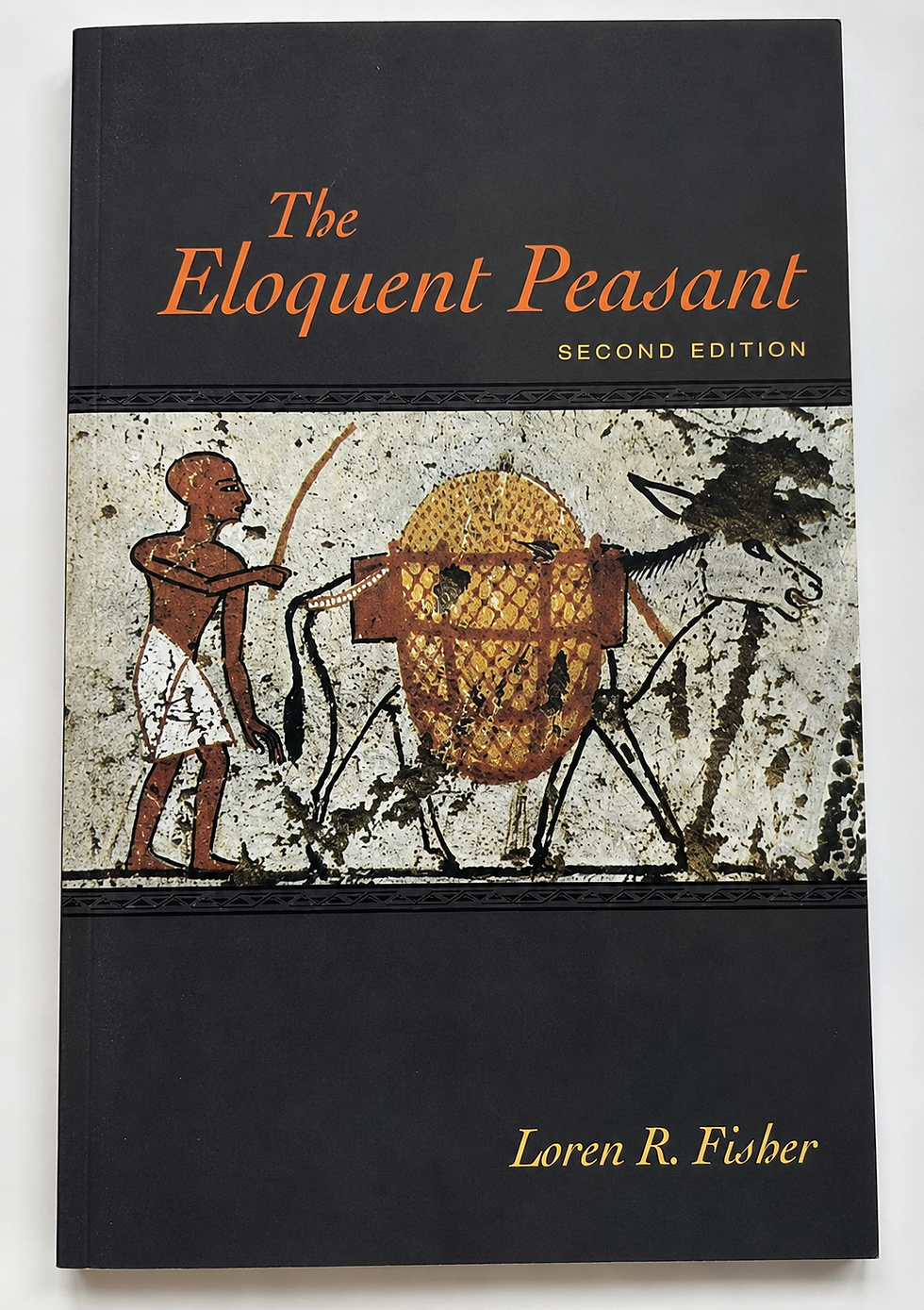
The Eloquent Peasant is an African literary masterpiece recorded in Kemet (ancient Egypt) during the Middle Kingdom, around 1850 BCE, telling how Khun-Anup demands justice through nine extraordinary speeches grounded in Ma’at—truth, justice, balance, and right order. It comes from a period when Kemet was ruled by its indigenous African population and ruling class, preserving in writing an African tradition of law, moral responsibility, and justice nearly four thousand years ago.

Comments